The growth equation: sell more, spend smarter

The latest Horváth CxO Priorities Study points to a simple challenge for FMCG private label manufacturers and retailers: growth is getting harder, while pressure on margins is increasing.

The survey shows that 72% of manufacturing revenue growth is expected to come from selling more products, rather than charging higher prices. Pricing power remains limited because of strong competition, excess capacity and high price transparency.

This makes the growth equation relatively straightforward: sell more, offer the right products and keep costs under control. For manufacturers, this means focusing the product range, speeding up innovation, improving pricing where possible, and making supply chains and production more efficient. Innovation and R&D remain important, but companies are also looking closely at how and where products are made.

There are also costs that can easily be overlooked. The survey highlights not only materials and direct production, but also indirect factory costs, R&D and engineering, IT, SG&A and other overheads. Manufacturers are therefore looking beyond simple cost-cutting and towards simpler processes, better use of materials, automation and more efficient ways of working.

Across the wider CPG landscape, the main priorities are AI and digital tools, improving costs and profits, supply-chain resilience, innovation and cyber security. AI is increasingly being used in everyday operations, although poor data, lack of skills and difficulties connecting AI to existing processes are still holding companies back.

Horváth Management Consultancy will discuss “The New Growth Equation: What Consumer Goods Leaders are Prioritising for 2027” at PLMA’s Lunch and Learn webinar on Wednesday, 2 December from 12:30-13:30 CET. To request a registration link, click here.
Suppliers from some 60 countries to exhibit at PLMA's US Show

Led by an array of countries whose products provide American consumers with a desirable and familiar flair, more national pavilions and international exhibitors than ever will participate in PLMA's 2026 US Private Label Trade Show. There will also be a larger number of US suppliers of international products. The Store Brands Marketplace will present 50 country pavilions and 1,000 international suppliers. “PLMA’s Chicago Show has become a gateway for international products, reflecting a rising demand for global flavours and diverse cuisines by US consumers," says Enriketa Beluli, PLMA’s Manager of Global Pavilions. "The strong expansion comes as sales of ethnic and international products are also growing across multiple categories and in mainstream supermarkets and specialized stores," adds Peggy Davies, PLMA president. The US show will take place 15-17 November in Chicago.

NEW NEWS TEST NODE

New Test Node New Test Node New Test Node New Test Node New Test Node New Test Node New Test Node New Test Node New Test Node New Test Node New Test Node New Test Node New Test Node New Test Node New Test Node New Test Node New Test Node New Test Node New Test Node New Test Node New Test Node New Test Node New Test Node New Test Node New Test Node New Test Node New Test Node New Test Node New Test Node New Test Node New Test Node New Test Node New Test Node New Test Node New Test Node New Test Node New Test Node New Test Node New Test Node New Test Node New Test Node New Test Node New Test Node 

Private Label Summit 2026: Where the future of private label takes shape

As the private label industry continues to evolve at pace, staying connected to emerging trends, new ideas, and influential decision-makers has never been more important. On 28 and 29 October, industry professionals from across Europe and beyond will gather in Manchester for PLMA’s annual Private Label Summit.

The Summit offers a unique opportunity to step away from day-to-day business and gain fresh perspectives on the forces shaping the future of private label. Over two days, manufacturers, retailers, consultants, and trade media will come together to exchange insights, discuss market developments, and explore new opportunities for growth.

While the programme is still preliminary, attendees can expect a dynamic mix of expert presentations, interactive discussions, networking opportunities, and an exclusive look at one of Europe’s most innovative retail markets. Manchester provides the perfect backdrop, offering access to leading retailers and a vibrant business environment known for innovation and change.

Beyond the sessions themselves, the Summit is about making valuable connections and discovering ideas that can inspire future strategies. Whether you are looking to understand shifting consumer behaviour, strengthen partnerships, or anticipate what comes next, this year’s event promises to be one worth attending.

More details on the Summit can be found here.

Organic momentum builds at PLMA as De Bioborrel's Organic Happy Hour brings industry together in Amsterdam

Organic and plant-based products continue to gain momentum across Europe’s private label sector, a trend clearly reflected at PLMA’s World of Private Label International Trade Show, taking place on 19–20 May at the RAI Amsterdam. With around 30% of the exhibition floor dedicated to organic, vegan and plant-based offerings, including dedicated organic pavilions organised by Food From Denmark, Consorzio Il Biologico and the Polish Chamber of Organic Food, the event underscores a broader shift towards more sustainable and health-conscious consumption.

Against this backdrop, De BioBorrel, a Dutch non-profit initiative focused on strengthening connections across the organic value chain, will host its Organic Happy Hour networking event on Tuesday 19 May from 18:30 to 19:30 in the Emerald Lounge at the RAI. Founded in 2017, De BioBorrel brings together stakeholders ranging from farmers and processors to retailers and consumers, with the aim of supporting the transition to a more sustainable food system.

The event will feature a keynote by Paul Holmbeck, a recognised authority in the organic sector and former Director of Organic Denmark. Holmbeck now advises governments, retailers and industry bodies across Europe on strategies to accelerate organic growth.

The networking session, which includes organic refreshments, offers attendees an opportunity to exchange insights and explore the commercial potential of organics in private label. Only a limited number of tickets is available for this event, so if you are interested in hearing more from Paul Holmbeck on organics, and what it could do for your company, make sure to reserve your spot directly from De BioBorrel via this link.

Cost: €15 p.p. including two organic drinks and bites.

PLMA’s European Private Label Market Report available online

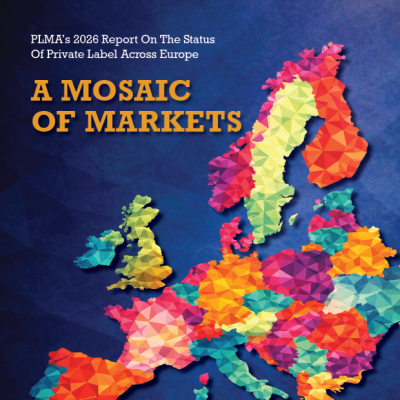
PLMA’s first ever, annual European Private Label Market Report, titled "A Mosaic of Markets: PLMA’s 2026 Report On The Status Of Private Label Across Europe," is now available online. 

The report details sales results during 2025 of both private label and manufacturer brands across seventeen countries monitored exclusively for the Private Label Manufacturers Association International Council by NielsenIQ. Going forward, it is PLMA’s plan to provide the report yearly to members, retailers and others in the European private label community.

As 2026 begins, US private label unit sales continue to trend up

Private label unit sales in the US, on the heels of a strong finish in Q4 of 2025, carried the momentum into the new year with a solid 2.3% gain for the period ending January 25, per Circana's first 2026 report to PLMA. National brands advanced by 2.4%. 

After a subpar start to 2025, the final three months were much improved for retailer brand unit sales as they increased an aggregate of 4.6% over the same period a year ago. 

Own brand dollar sales for the month of January 2026 were also positive, up by 2.3%; national brands were ahead 4.6%.

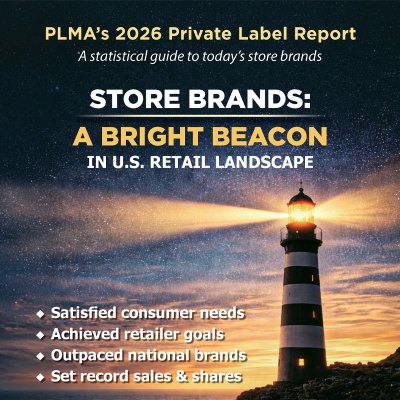
PLMA’s 2026 US Private Label Report, "Store Brands: A Bright Beacon In U.S. Retail Landscape," which documents the unprecedented levels of market penetration achieved by the store brands industry last year, is available online at www.plma.com.

Understanding your customer on an emotional level

Too many marketing decisions are still driven by what the company likes or wants—rather than by what its customer actually values. While many organisations proudly claim to be customer-centric, the reality often tells a different story. In marketing and sales, this disconnect can be a costly business mistake.

Ask a consumer why they buy a particular product and you are unlikely to get a reliable answer. Often, people simply don’t know—or they rationalise their choice after the fact. In truth, purchasing decisions are largely driven by emotion. This is where effective marketing and sales succeed: by understanding and triggering the emotions that influence consumer choice.

Store design, product layout, colours, fonts, language and messaging all play a role in shaping emotional responses. When used well, these elements attract customers and build preference. Crucially, this applies not only to end consumers, but also to B2B customers. The same emotional drivers are at work, and the same marketing and sales tools can be applied.

However, not all customers are the same.

That is why Buylogic has developed a customer segmentation model designed specifically for marketing professionals. Unlike traditional segmentation approaches based on demographics such as age, gender, income or geography, this model is rooted in psychology, market and empirical research, communication theory and neuroscience. It focuses on what truly motivates customers to buy at an emotional level—whether they are consumers or B2B decision-makers.

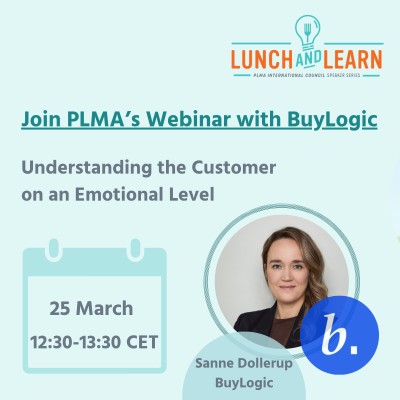
On 25 March, from 12:30 to 13:30 CET, Sanne Dollerup of Buylogic will host an online webinar exploring emotional customer segmentation and the emotional drivers behind purchasing decisions.

The session is part of PLMA’s Lunch & Learn series and is free for PLMA members and retailers. To request a registration link, click here.
PLMA in the US presents: Euromonitor International Top Global Consumer Trends 2026 Thursday, 29 January 2026, 18:30 CET

Carmen Silva presents Euromonitor International’s key global consumer trends for 2026, outlining how shifting values are reshaping behaviour and driving disruption across markets.

Comfort Zone

Personal protection and emotional security are replacing traditional escapism. Consumers seek calmer, value-led lives in response to ongoing uncertainty. Businesses should support wellbeing through solutions that offer reassurance, control and simplicity.

Fiercely Unfiltered

Authenticity and radical self-expression are gaining momentum. Consumers are rejecting uniformity in favour of individuality and honesty. Brands must move beyond standardised approaches and demonstrate genuine understanding of diverse identities.

Rewired Wellness

Wellness is becoming more clinical and technology driven. Consumers are adopting advanced, science-led solutions over conventional routines. Brands are expected to act as partners, supporting personalised and data-led health journeys.

Next Asian Wave

East Asian influence continues to expand globally, combining innovation, affordability and seamless digital experiences. Companies should track these developments closely and adopt agile, tech-enabled models that deliver speed and convenience.

Carmen Silva is Senior Consultant at Euromonitor International; she leads beauty and fashion research across Latin America. An economist by training, she specialises in beauty and consumer health, combining qualitative insight with econometric forecasting to assess consumption trends and market dynamics across industries.

For more information on the webinar, contact: education@plma.nl

Enhance your Private Label Expertise with PLMA’s Online Executive Education Programme

PLMA’s Online Executive Education Programme 2026, 4–5 March, offers executives a concise yet powerful update on the fast-evolving private label landscape. Across two focused morning sessions, leading industry experts will explore the trends, strategies and skills shaping private brand success.

Highlights include insights into global retail trends, private label strategy, sourcing developments, innovation in grocery, shopper behaviour, and the latest packaging design advances. Speakers include Ray Gaul (Retail Cities), Jens Sievert (Daymon), Marijn Overvest (Procurement Tactics), Alexander Bilsing (Simon Kucher), Food by Design, and an interview with former Walmart Vice-President Arjan Both. The programme is moderated by Edgar Elzerman of Elzerman Consulting.


For more programme details, click here.